

Newsletter: June 2025
You open a letter from your doctors office and suddenly think: “wait… I owe how much?”
Don’t panic, you’re not alone. Medical bills can be confusing, and The IPM Group is here to help you understand what you’re looking at, what you actually owe, and why.
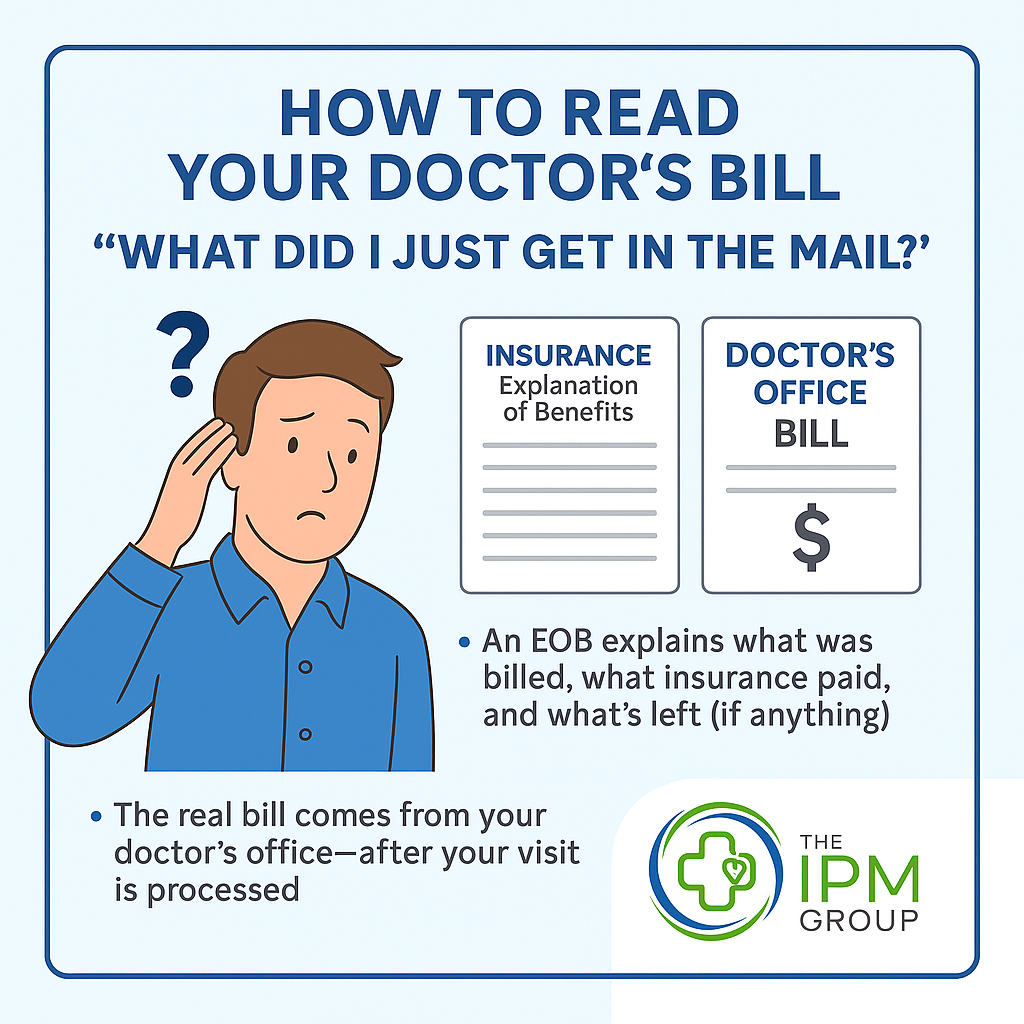
First Things First: Is This Even a Bill?
Often, the first document you receive is not a bill—it’s an Explanation of Benefits (EOB) from your insurance company.
How to Tell:
- EOB = comes from your insurance company
- Bill = comes from the doctors office
Your EOB outlines what services were billed, what your insurance covered, and what amount (if any) you might be responsible for. Your actual bill comes shortly after we receive the same EOB.
Why Do I Owe Anything?
Great question. It depends on:
-
Your insurance plan (co-pays, deductibles, co-insurance)
-
The services provided
-
Whether your deductible has been met
Example: Let’s say your plan’s contracted rate for a visit is $100.
-
You paid a $20 co-pay
-
Your insurance owes $80
-
BUT, if your deductible isn’t met, you may owe that $80 instead
Why Was I Billed More Than Expected?
Here’s where the contractual rate comes in. This is the price your insurance and The IPM Group agreed on for a service.
Sometimes, we have to estimate and bill at a higher rate because:
-
Insurance companies don’t always provide current rate info
-
Rates can change without notice
Important: You are NEVER responsible for more than the contractual rate. If our estimate was too high, we adjust it off your bill before it gets to you.
Example: We billed $120, but the true rate is $100
-
You already paid $20 co-pay
-
Your bill should only be $80
What You Should Do.
- Check that what you received is a bill, not an EOB
- Ask us or your insurance about the contractual rate
- Review your bill side-by-side with your EOB
- Make sure any overages are adjusted off before you pay
Conclusion.
At The IPM Group, we believe you deserve to understand what you’re paying for. Our team is always here to walk you through your bill, step-by-step. Because informed patients make empowered healthcare decisions.